Assassination by Seashell and Other Brilliant CIA Operations
(The 3 Craziest CIA Operations of All Time)
Have you ever asked yourself, “I wonder what our Central Intelligence Agency is up to right now?” That’s the type of question that keeps me awake on sleepless nights. If you believe Hollywood, the CIA probably has agents deep in enemy territory trying to disarm a world-ending nuclear bomb with only seconds left on the clock. If you’re more sensible, maybe you believe that they’re constantly detecting and monitoring threats from a carefully constructed network of spies and informants, all while protecting the secrets that keep us all safe. But what if I told you that right now the CIA is hard at work:
1. Planning to assassinate the leader of a foreign nation with a seashell
2. Recruiting a psychic army to test the use of mind control for covert operations
4. Churning out thousands of bootleg copies of classic novels?
You’d think that I am a nutcase in a tinfoil hat, and I don’t blame you. That sounds insane. But I promise, every single one of the operations that I just listed for you was researched and carried out by the CIA.
Now if I told you that these plots were all from the Cold War; you might believe it. The Cold War was a particularly crazy time in American history. With the fate of the world hanging in the balance, the CIA had to investigate any lead that might give them any edge over the Russians. But unfortunately, I would be lying if I told you that Cold War hysteria was responsible for all of these schemes (it’s definitely responsible for some), because the most recent operation from those I listed was from the late 90’s. I bet now you’re dying to know what crazy shenanigans Bill Clinton’s CIA got up to. Well luckily, I’m just the man to tell you. Sit back, and I’ll tell you about 3 of the craziest CIA operations ever conducted.
1- Fidel Castro was Almost Assassinated by a Seashell in the 90’s
In 1959, a young charismatic nationalist lead a guerilla army through the streets of Havana and overthrew the American-backed Cuban president. That man was Fidel Castro. As he grew in power, Castro masterminded the Cuban Missile Crisis by siding with the USSR and secretly building nuclear missile silos right off the coast of Florida. The US initiated a naval blockade in order to prevent the missiles from reaching the silos, and the world held its breath while Washington and Moscow bickered violently over who would back down first. The world hovered on the brink of nuclear holocaust for 13 days until the crisis was averted. And ever since that fateful day, the CIA held just a bit of a grudge against Castro. Wayne Smith, the former head of the US interests section in Havana, has a quote which perfectly sums up the US's history with Cuba: "'Cuba seems to have the same effect on American administrations that a full moon has on a werewolf. We may not sprout hair and howl but we behave in the same way.'" (Campbell 1) The CIA desperately tried everything to assassinate him over the course of decades: an operative armed with a poison syringe disguised as a pen, a former lover armed with poison pills, a poison laced diving suit, even an exploding cigar! My personal favorite is their plan from the 1990's to kill the dictator with a booby-trapped seashell packed full of high explosives. Castro was well known for his love of diving, and often started his days with a morning swim. The plan was to lure Castro into a trap during his morning swim by attracting him with a "spectacular" seashell which would detonate when picked up. However, after extensive research it was determined by the CIA that: “No shells in the Caribbean are large enough to hold a sufficient amount of explosive which was (sic) spectacular enough to attract the attention of Castro.” (Lubben 3). Castro became a living legend among his people, claiming to have escaped death "634 times"(Campbell 1). Castro died at the ripe old age of 90, of natural causes.
 |
| https://www.worldatlas.com/articles/why-do-you-hear-the-ocean-in-a-seashell.html |
2- Stargate Program and the Psychic Army
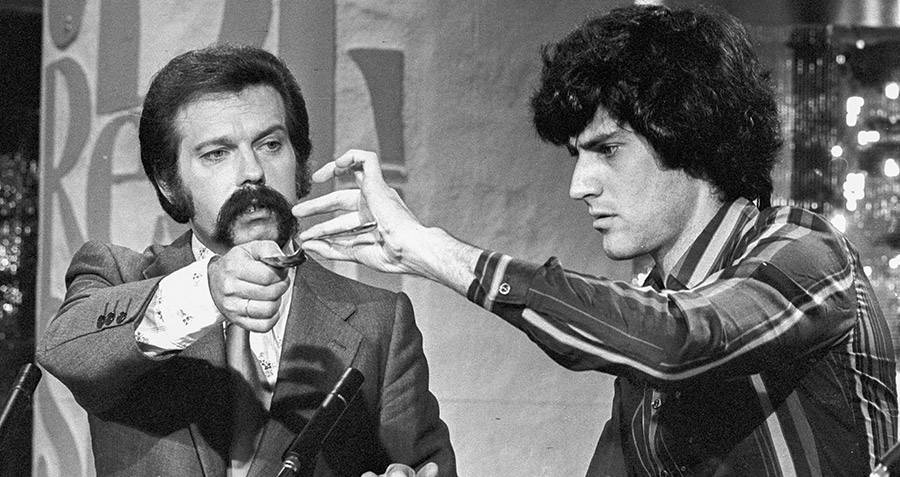
Have you ever tried bending spoons? I don't mean with your hands, I mean with your mind like Uri Geller. I know for a fact that anyone who has seen The Matrix has tried it at least once. Well that includes the CIA too. Their experiments ran from 1978-1995 as part of a program called Stargate which aimed to recruit and interview "Psychoenergetic" individuals for testing the practical applications of psychic powers. They define this in their official dossier on the subject as “A mental process by which an individual perceives, communicates with, and/or perturbs characteristics of a designated target, person, or event which is remote in space and/or time from that individual”(General Dossier 1). Their project hoped to discover the secrets to "Remote Viewing" a technique which hoped to have operatives access their psychic powers in order to predict events that were beyond their sensory perception. The sorts of tests they performed can be found in the official CIA documents I have included in my works cited. You can find the testing protocols for recruiting new psychic agents (Project N1-X) where operatives were asked to locate a hidden document without leaving the room, and you can view the intelligence report of an actual event analysis (Project 8122) where operatives were asked to locate a crate of explosives stolen from a bunker which includes detailed sketches of the psychic's description of the getaway car and the building where the explosives were stored in the interview notes. It's far too easy to give the CIA a hard time for recruiting psychics to teach them mind control powers (we've all done it), but in the end Project Stargate did have a twisted sort of logic to it: "the benefits include the fact that it is 'passive', 'inexpensive' and that there is 'no known defense'"(Griffin 2).
 |
| https://allthatsinteresting.com/remote-viewing-project-stargate |
3- Doctor Zhivago or: How I Learned to Stop Worrying and Love Copyright Infringement
In 1958, the CIA discovered a book called Doctor Zhivago by Russian author Boris Pasternak and instantly fell in love. The book was the perfect propaganda tool, "Pasternak’s humanistic message — that every person is entitled to a private life and deserves respect as a human being, irrespective of the extent of his political loyalty or contribution to the state — poses a fundamental challenge to the Soviet ethic of sacrifice of the individual to the Communist system" (Finn 1). The USSR banned Doctor Zhivago before it had the chance to be printed, but foreign editions managed to make it to the presses. The CIA managed to snag an early transcript and paid for a small print run of the novel by the Hague so that they could pass out the novel at the 1958 world fair. Since they couldn't pass out the novel at the US booth at the fair, they teamed up with the Vatican, who agreed to pass out the books to Russians that prayed in the small chapel at their pavilion. There was only one small problem: all of this was completely illegal by accident: "The CIA had anticipated that the Dutch publisher would sign a contract with Feltrinelli, Pasternak’s Milan publisher, and that the books handed out in Brussels would be seen as part of that print run. The contract was never signed, and the Russian-language edition printed in The Hague was illegal. The Italian publisher, who held the rights to “Doctor Zhivago,” was furious when he learned about the distribution of the novel in Brussels. The furor sparked press interest and rumors, never confirmed, of involvement by the CIA." (Finn 5) After their involvement was discovered, the CIA saw how furious the covert distribution of the novel made the Kremlin and immediately ramped up their efforts to distribute the novel. They dove headfirst into the business of copyright infringement and opened up a printing press at CIA headquarters, preparing for the 1959 World Festival of Youth and Students for Peace and Friendship in Vienna by mass producing classic anti-communist literature: "There was a significant effort to distribute books in Vienna — about 30,000 in 14 languages, including 1984, Animal Farm, The God That Failed and Doctor Zhivago" (Finn 5). No contracts were negotiated, but at least the CIA's efforts got Pasternak the literary attention he deserved, later winning him the Nobel Prize for literature.
 |
| https://www.pinterest.com/pin/95771929547232848/ |
Don't get me wrong, I love the CIA. They have done more for this country then we can ever even begin to know or understand (mostly because they'll never give us the chance to know but I guess that counts for something). The CIA’s ultimate mission is to fight to save democracy every day without anyone knowing or ever asking for recognition. If anything, this article only demonstrates the CIA’s commitment to keeping us safe, no matter the cost, even if that means blowing up a dictator with a seashell every so often to protect our freedoms. By doing so, they protect your God-given right to get up from your desk right now and fly to Atlanta, Georgia so that you can attempt to finish an 11-pound pizza for a chance at a $250 cash prize. If that isn't freedom, then I certainly don't know what is.
Works Cited
"Fidel Castro: Dodging Exploding Seashells, Poison Pens and Ex-lovers." BBC News. BBC, 27 Nov. 2016. Web. 30 Sept. 2019. <https://www.bbc.com/news/world-latin-america-38121583>.
Finn, Peter, and Petra Couvée. "During Cold War, CIA Used 'Doctor Zhivago' as a Tool to Undermine Soviet Union." The Washington Post. WP Company, 05 Apr. 2014. Web. 30 Sept. 2019.
Griffin, Andrew. "CIA Releases Classified Documents on Psychic Control Plans." The Independent. Independent Digital News and Media, 18 Jan. 2017. Web. 30 Sept. 2019.
History.com Editors. “Bay of Pigs Invasion.” History.com, A&E Television Networks, 27 Oct. 2009, www.history.com/topics/cold-war/bay-of-pigs-invasion.
Lubben, Alex. "The 6 Craziest CIA Plots to Kill Fidel Castro." Vice. N.p., 27 Oct. 2017. Web. 30 Sept. 2019.
"Project Stargate General Dossier." Freedom of Information Act Electronic Reading Room. Central Intelligence Agency, 8 Aug. 2000. Web. 30 Sept. 2019. <https://www.cia.gov/library/readingroom/docs/CIA-RDP96-00789R003300210001-2.pdf>.
"Project Stargate-(Project 8122)." Freedom of Information Act Electronic Reading Room. Central Intelligence Agency, 17 Jan. 2003. Web. 30 Sept. 2019. <https://www.cia.gov/library/readingroom/docs/CIA-RDP96-00788R000600970009-2.pdf>.
"Project Stargate-(Project N1-X)." Freedom of Information Act Electronic Reading Room. Central Intelligence Agency, 17 Jan. 2003. Web. 30 Sept. 2019. <https://www.cia.gov/library/readingroom/docs/CIA-RDP96-00789R003700710001-3.pdf>.
“The Cuban Missile Crisis, October 1962 .” Milestones: 1961–1968, U.S. Department of State Office of the Historian, history.state.gov/milestones/1961-1968/cuban-missile-crisis. <https://history.state.gov/milestones/1961-1968/cuban-missile-crisis>.

These missions are absolutely ridiculous. I wish the seashell mission would've worked out, just such a bizarre and random way to try to kill someone. Hard to believe the seashell size is what held them back.
ReplyDeleteAs Criminal Minds is my favorite show, I loved reading about the CIA and their missions. There's truly so much that we don't know about what they're doing or have done.
ReplyDelete-Taylor Berry
I know I talked to you about your article before you wrote it but the details of these missions are laughable. I mean c'mon. This article is awesome. Thank you for doing this.
ReplyDelete